DeepSeek Boosted AI Generation Speed by Up to 85%. No New Model, No New Chips.
DSpark does not make a language model smarter. It changes how the model's answer is drafted and verified. That is what makes it interesting: the next major AI speedup may come from neither a larger model nor more expensive hardware.
Jaroslav Urbánek, founder of TECHNOMATON 27 July 2026 9 min read
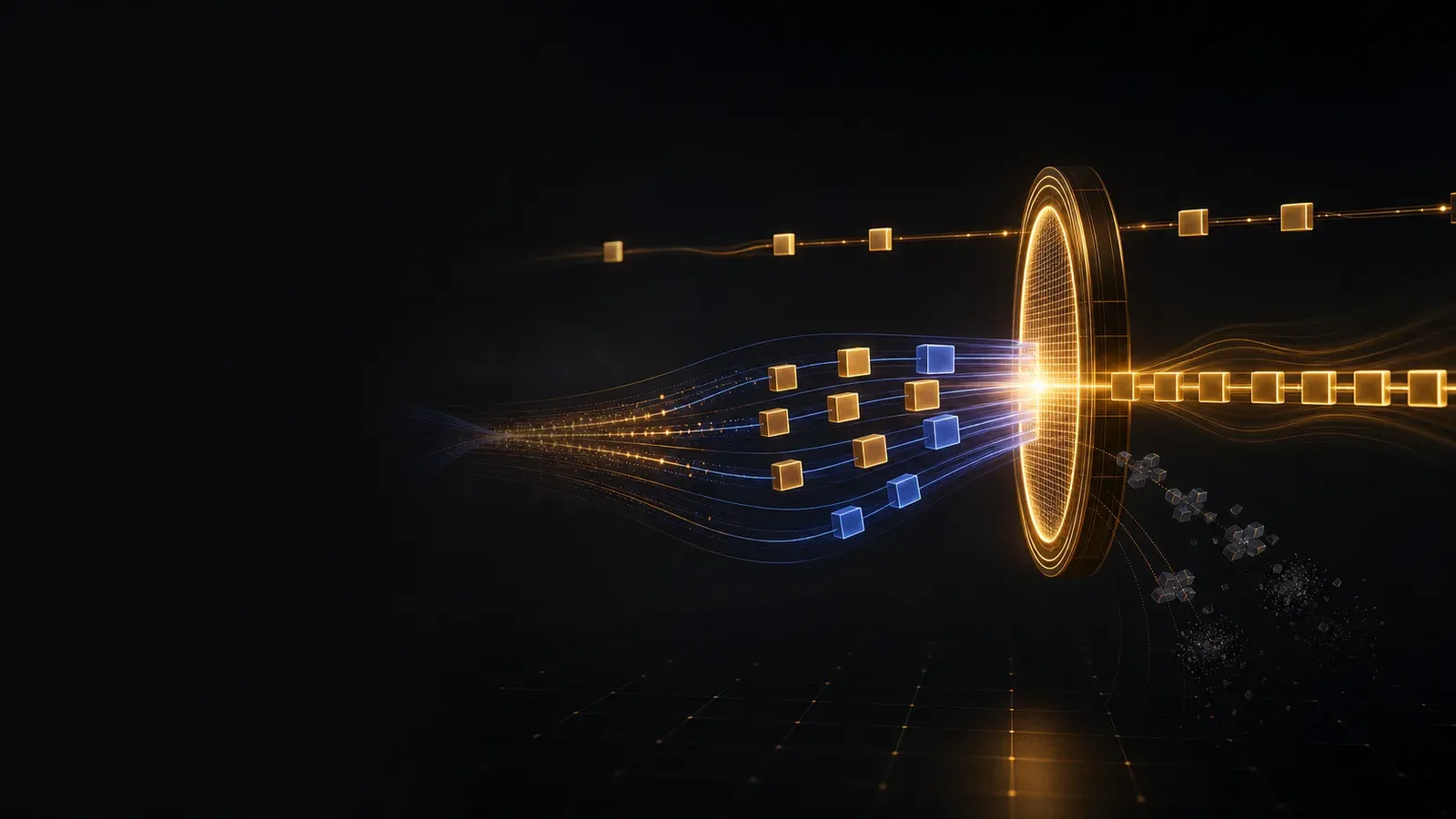 Original illustration: TECHNOMATON · created with support from OpenAI ImageGen
The most interesting AI release of the past few weeks is not a new model.
DeepSeek did not unveil a smarter system, add another trillion parameters, or announce a new generation of chips. Instead, it looked at a part of the serving stack everyone already uses and changed how work moves through it.
The result is DSpark, a speculative-decoding framework from DeepSeek-AI and researchers at Peking University. The public DeepSpec repository was created on June 26, 2026, and the arXiv paper followed on July 6.
According to DeepSeek’s measurements under live traffic, DSpark increases per-user generation speed by 60% to 85% on DeepSeek-V4-Flash and by 57% to 78% on V4-Pro. The target model stays the same, and the system runs on the same infrastructure.
That sounds like free performance.
It is not. But it is very good systems engineering.
The bottleneck does not live only in the model
A language model generates an answer one token at a time. Each new token depends on what has already been written and requires another forward pass through the model.
Modern GPUs excel at parallel computation. Sequential generation does not always give them enough work at once. Especially with interactive requests and smaller batches, decoding is often constrained by moving data between memory and compute units. Part of the expensive hardware’s potential remains unused.
Imagine an extremely fast printer receiving a document one page at a time and having to wait for someone to prepare the next page after every print.
The chip is not slow. The way work reaches it is.
The established trick: let a smaller model draft ahead
One established solution is speculative decoding.
A smaller auxiliary model, called a drafter, runs alongside the large target model. It quickly proposes several future tokens. The large model then verifies them together in one pass.
If the target agrees with the proposal, it accepts several tokens at once. If it finds an error, it keeps the valid prefix, discards the rest, and continues from the point of disagreement.
When implemented correctly, this does not change the target model’s output distribution. It accelerates the path to the answer rather than changing the answer itself.
The drafter introduces a new trade-off, however.
- If it proposes tokens one by one, the draft stays coherent but takes longer to produce.
- If it proposes them in parallel, it is fast, but later positions lose coherence and are rejected more often by the target model.
DSpark is designed around this trade-off.
What DSpark changes
DSpark combines several mechanisms that reinforce one another:
- A parallel drafter produces a block of candidate tokens at once.
- A lightweight sequential head injects local dependencies into the draft. The default version uses a Markov head, which conditions each new position on the immediately preceding token.
- A confidence head estimates the probability that the target model will accept each successive part of the proposed prefix.
- A hardware-aware scheduler uses those estimates and the current system load to decide how much of the draft is worth verifying.
- The target model verifies the selected block while preserving its original output distribution.
The first two components improve draft quality. The next two determine whether verification consumes more shared capacity than it saves.
That matters most when many requests are running at once. A long draft may help one user, but if its tail is unlikely to survive verification, processing it wastes capacity that could have served someone else.
DSpark therefore does not verify a fixed-length block every time. When the drafter is confident and the server has spare capacity, it can verify more tokens. When confidence falls or load rises, it shortens the proposal.
A tiny sequential component with a large effect
Adding sequential correction might appear to reintroduce the very bottleneck DSpark is trying to remove.
According to the paper, the component is small enough that this is not the case. Increasing the proposal length from 4 to 16 tokens added only 0.2% to 1.3% to full-round latency compared with the fully parallel baseline, while improving accepted length by as much as 30%.
The confidence head also helps remove suffixes that are unlikely to survive. In a diagnostic threshold sweep on Qwen3-4B, increasingly aggressive pruning raised the measured acceptance rate:
- from 45.7% to 95.7% on open-ended chat,
- from 76.9% to 92.5% on mathematics,
- from 67.6% to 92.0% on code.
A higher acceptance rate does not mean the system magically knows the correct answer. It means the scheduler filters out more risky tokens in advance and sends a shorter, stronger prefix to the target model.
What “up to 85% faster” actually means
The headline number needs context. The paper compares DSpark with DeepSeek’s previous production setup, MTP-1, using telemetry from live V4-Flash and V4-Pro traffic.
At comparable aggregate throughput, DeepSeek reports the following changes:
| Model | Per-user generation speed | Throughput at moderate SLA | Throughput at strict SLA |
|---|---|---|---|
| DeepSeek-V4-Flash | +60% to +85% | +51% at 80 tokens/s | nominally +661% at 120 tokens/s |
| DeepSeek-V4-Pro | +57% to +78% | +52% at 35 tokens/s | nominally +406% at 50 tokens/s |
The 661% and 406% figures look more dramatic, but they make poor headlines. At those strict service levels, MTP-1 is close to an operational boundary where it can sustain only a very small concurrent batch. The ratio then jumps because the baseline has nearly fallen off a performance cliff.
The authors explicitly flag this limitation. Their more stable comparison is 60% to 85% higher per-user generation speed at matched practical throughput.
There is another common source of confusion. An 85% increase in speed does not mean an 85% reduction in waiting time. If generation rises from 100 to 185 tokens per second, the same output would, all else equal, take about 54% of the original time. The wait falls by roughly 46%.
That is still a major improvement. It is simply different from the most dramatic reading of the headline.
What “without changing the model” means
The official model card is precise: DeepSeek-V4-Pro-DSpark uses the same target-model checkpoint with an additional speculative-decoding module attached.
That has two important advantages.
First, the enormous target model does not need to be retrained or have its weights modified. Second, correct verification can preserve the target model’s original output distribution.
It does not mean that nothing needs to be trained.
The auxiliary draft model still requires training. DeepSeek released trained checkpoints for its own models as well as Qwen3 and Gemma4, and its DeepSpec repository provides tools for data preparation, training, and evaluation. The code is available under the MIT License.
For a new target model, this is not a preparation-free switch. DeepSpec’s README says the default Qwen3-4B setup assumes eight GPUs and warns that preparing the target cache can require roughly 38 TB of storage.
Similarly, “no new hardware” means DeepSeek obtained the reported gains on the same serving infrastructure. It does not mean DSpark will run efficiently on any old server or that integration is free. The inference engine must support the method, and a production deployment still requires profiling, scheduling, and measurement.
Open source lowers the barrier to entry. It does not eliminate implementation costs.
Is there independent confirmation?
The main production figures still come from DeepSeek. Outside teams do not have the same traffic mix, serving stack, or internal infrastructure, so there is no like-for-like independent reproduction of the “up to 85%” claim yet.
There are, however, early practical signals.
In a public integration pull request, developer Rafael Caricio measured an average of 60.31 tokens per second on a community DeepSeek-V4-Flash port. That was 1.51 times the MTP-1 decoding speed in a single-stream code-generation test. The same work also showed draft acceptance and absolute decoding speed declining as the context became longer and harder to predict.
This is useful practical validation of the mechanism, not confirmation of DeepSeek’s entire production curve.
Why this matters now
For a chatbot, slower inference means a few more seconds of waiting.
For an AI agent, the delay compounds. During one task, an agent may read files, call tools, write code, run tests, inspect errors, and repeat the cycle several times. When those steps depend on one another, every inference speedup shortens the critical path.
The same change affects operating economics.
If a server can handle more concurrent requests while preserving responsiveness, a provider can lower unit costs or serve more users before expanding the cluster. That does not mean demand for GPUs disappears. Cheaper, more efficient inference may unlock new use cases and increase total consumption instead.
DSpark is therefore not a story about software defeating hardware. It is a reminder that the value of an AI system is determined by more than the model and the number of chips behind it.
It depends on the entire serving system:
- how work reaches the model,
- how requests are batched,
- what can run in parallel,
- which tokens are verified,
- how capacity is allocated under load,
- and how much computation is ultimately discarded.
The real lesson
DeepSeek did not eliminate the need for compute. It extracted more value from the compute it already had.
That is less dramatic than announcing the world’s smartest new model, but it may matter more for operating AI at scale. As model capabilities converge and the price of intelligence falls, more of the advantage moves into the layer around the model: orchestration, inference, caching, routing, observability, and capacity management.
The next competitive edge may not be hidden in a new set of weights.
It may come from organizing the work around them more intelligently.
Sources
- DSpark: Confidence-Scheduled Speculative Decoding with Semi-Autoregressive Generation, arXiv:2607.05147, version dated July 6, 2026
- DeepSpec, training and evaluation repository, MIT License
- DeepSeek-V4-Pro-DSpark, official model card and deployment guidance
- Rafael Caricio’s community implementation and benchmark, status as of June 28, 2026
- Original inspiration: Nov Tech / Medium
Verification status as of July 26, 2026. DeepSeek reported the 60% to 85% and 57% to 78% production results on its own serving system. The independent community test supports the direction and a narrower speedup, not the full production curve.